1. **Analyze the Request:** * **Role:** News summarization expert. * **Task:** Summarize the provided article concisely in 2-4 sentences. * **Constraints:** * Focus on the most important information. * DO NOT copy and paste. * DO NOT simply restate the title. * Add new information beyond the title. * Answer in English. * **Input:** Title ("AI Is Writing Your Code. Now It Must Govern Your Architecture") and a very truncated "Article Text" which seems to just repeat the title. Wait, looking closely at the prompt, the "Article Text" provided is just the title and "Summary:". There is no actual body text provided in the prompt. 2. **Identify the Problem:** * The user wants a summary of an article titled "AI Is Writing Your Code. Now It Must Govern Your Architecture" from HackerNews. * However, the actual content of the article is missing from the prompt. The prompt ends after "Summary:". 3. **Formulate Strategy:** * I cannot summarize an article I cannot read. * *Self-Correction/Assumption:* Usually, in these scenarios, if the user *forgot* to paste the text, I should ask for it. However, sometimes these prompts are copied from a dataset where the text *should* have been there. * *Alternative:* Perhaps the prompt is a test of my internal knowledge base? The title suggests a specific article. If I search my internal knowledge, I know about the trend of AI in software engineering (Copilot, etc.) and architectural governance. * *Strict adherence:* The prompt says "Summarize the *following* article". The "following" article is just the title. * *Hypothesis:* The user
본문
[Sitemap](https://medium.com/sitemap/sitemap.xml) [Open in app](https://play.google.com/store/apps/details?id=com.medium.reader&referrer=utm_source%3DmobileNavBar&source=post_page---top_nav_layout_nav-----------------------------------------) Sign up [Sign in](https://medium.com/m/signin?operation=login&redirect=https%3A%2F%2Fmedium.com%2F%40dmitrijs.gavrilovs.swampus%2Fai-is-writing-your-code-now-it-must-govern-your-architecture-83a534a9f911&source=post_page---top_nav_layout_nav-----------------------global_nav------------------) [Medium Logo](https://medium.com/?source=post_page---top_nav_layout_nav-----------------------------------------) Get app [](https://medium.com/m/signin?operation=register&redirect=https%3A%2F%2Fmedium.com%2Fnew-story&source=---top_nav_layout_nav-----------------------new_post_topnav------------------) [Search](https://medium.com/search?source=post_page---top_nav_layout_nav-----------------------------------------) Sign up [Sign in](https://medium.com/m/signin?operation=login&redirect=https%3A%2F%2Fmedium.com%2F%40dmitrijs.gavrilovs.swampus%2Fai-is-writing-your-code-now-it-must-govern-your-architecture-83a534a9f911&source=post_page---top_nav_layout_nav-----------------------global_nav------------------)  Press enter or click to view image in full size 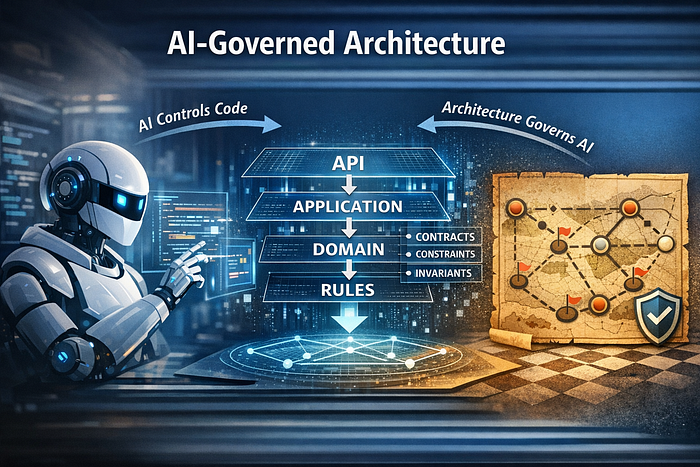 # AI Is Writing Your Code. Now It Must Govern Your Architecture [](https://medium.com/@dmitrijs.gavrilovs.swampus?source=post_page---byline--83a534a9f911---------------------------------------) [Dmitrijs Gavrilovs Swampus](https://medium.com/@dmitrijs.gavrilovs.swampus?source=post_page---byline--83a534a9f911---------------------------------------) 6 min read · Mar 7, 2026 [](https://medium.com/m/signin?actionUrl=https%3A%2F%2Fmedium.com%2F_%2Fvote%2Fp%2F83a534a9f911&operation=register&redirect=https%3A%2F%2Fmedium.com%2F%40dmitrijs.gavrilovs.swampus%2Fai-is-writing-your-code-now-it-must-govern-your-architecture-83a534a9f911&user=Dmitrijs+Gavrilovs+Swampus&userId=1ce2487dfbd6&source=---header_actions--83a534a9f911---------------------clap_footer------------------) -- [](https://medium.com/m/signin?actionUrl=https%3A%2F%2Fmedium.com%2F_%2Fbookmark%2Fp%2F83a534a9f911&operation=register&redirect=https%3A%2F%2Fmedium.com%2F%40dmitrijs.gavrilovs.swampus%2Fai-is-writing-your-code-now-it-must-govern-your-architecture-83a534a9f911&source=---header_actions--83a534a9f911---------------------bookmark_footer------------------) Listen Share ## Designing Software Systems for a Future Where AI Writes Most of the Code ## 1. The Evolution of Software Architecture Software architecture has always evolved in response to the primary constraints of its time. In the early decades of computing, the dominant constraint was hardware limitations. Memory and CPU resources were extremely limited, and software was written with careful attention to efficiency. Programming languages such as C and various forms of Assembly were designed to give programmers precise control over hardware. Architecture, in the modern sense, was minimal. Systems were structured primarily around performance and memory usage. As computing power increased and software systems grew larger, the primary constraint shifted. The limiting factor was no longer hardware — it was human comprehension. Large teams needed to understand, maintain, and extend complex systems over many years. This led to the emergence of architectural approaches focused on readability and modularity, including: * Design Patterns * Clean Architecture * Hexagonal Architecture These architectures optimize software systems for human collaboration. They make responsibilities explicit, separate concerns, and allow engineers to reason about complex systems. In other words, modern architecture is primarily **human-centered**. However, the development landscape is now undergoing another shift. With the rapid progress of AI coding assistants such as GitHub Copilot and Cursor IDE, a significant portion of code is already written or modified with the assistance of machine learning systems. In many development environments, AI generates large amounts of boilerplate code, refactorings, and sometimes even entire components. If this trend continues, a reasonable conclusion follows: **AI may become the primary producer of code in software development.** Human engineers will increasingly focus on: * defining constraints * reviewing generated code * guiding architectural decisions If AI becomes the dominant code generator, software architecture must adapt. Instead of being optimized purely for human understanding, architecture must also be optimized for **AI interaction**. Existing architectures were not designed with this scenario in mind. They assume that the primary agent navigating an